ITALY, FRANCE and BELGIUM (briefly)
Our advance parties had already taken over. Then this move was cancelled and we proceeded straight on to Naples where we embarked on M.T. and were taken over to the South of France and followed up behind the 5th Army. We were moved up through France , with our interpreter Jacques Theil (who later ran the Cafe Kleber near the Eiffel Tower) and Belgium and finally were bivouac billeted in Ghent. From here we were sent on leave to the U.K. and all members of the Unit during the next two months had a period of leave in the U.K. after an absence of over four years. This coupled with our civilised environment did a tremendous amount of good to the Unit and when we took over a position in the line once more, the unit was fit for anything. Prior to this we had undergone extensive training in river crossing and the latest technique against mines which had been encountered in Germany.
GERMANY
We saw the Air Armada for the river crossing over the Rhine and shortly and then afterwards we moved up towards Wesel and passed over the Rhine via Munster Osnabrucke, Hanover, Celle where we took an active part working with the Scottish Division. Our job was mainly road clearance - maintenance of tracks and improvised bridges - until after we had crossed the river Elbe. Here the division was directed on to Lubeck with the 17th Brigade. In the advance the brigade advanced on two roads with the forest in between them. One platoon accompanied the left hand battalion and the remainder of the Company moved up behind the main units on the main road. We spent all the time in clearing road blocks and on the day before the Armistice, one of our parties was caught on the left hand track in the open whilst clearing some road blocks and making good the road to enable the equipment to move up to the Seaforth Highlanders. They were heavily shelled by 2-Tiger Tanks left behind in a wood about 1,800 yards away and all eleven including Sgt Speirs? were completely destroyed. We built a small Bailey Bridge before Lubecke and I think it was one of the last operational bridges in Europe, so that we had the distinction of having completed the first one and the last one. We moved into Lubecke and our first tasks were the clearance and neutralising of the airfields and dock roads and arms dumps in the neighbourhood and then the preparation for the Victory celebrations. The Company constructed the Review Stand for the Victory Parade in Lubecke.
We took over all RE equipment and had the good fortune to take over several hundred German assault boats and mechanical oars, the local sailing club and many other amenities which needless to say we put to good use -
No sooner had we got settled than we were moved to Wisma and from there to Schwain where one of our main tasks was the setting up of the Divisional Sailing Club on the lake - from Schwein we moved to Magdeberg opposite the Russians and our job here was the clearance of the canal from Magdeberg to Brunswick of the eight or ten bridges which had been blown and dropped into the canal. Our task was the removal of 3 of these and in addition we got the lift Bridge of the Luzer? to the Elbe canal in working order and were able to bring out altogether over 80,000 tons of shipping - an interesting point was whilst bringing shipping from the Elbe, the Russians on the opposite shore mortared the area so we had to leave the barge nearest to them to its fate - as soon as this had been completed - the unit then moved back to Brunswick and finally to a small village south of Brunswick called Salz-Gitta - a mining village on the Herman Goering Iron Ore and Steelworks organisation. it was a modern village with plenty of comfortable houses into which we ensconced ourselves - and main task from now on was as follows * The clearing of the Bridges on the main canals - the two biggest being the one on the main Brunswick to Hanover road, where two large steel and concrete bridges has been dropped into the canal and had been replaced with an American trestle bridge. The central span had to be increased on this bridge to take all the canal traffic and also the heavy vehicles on the main road. When we were halfway through this it was found that the approach spans in theory were class 9 � although they had taken class 70. This was not good enough for the Deputy Chief Engineer of works and we then had to increase the strength of the approach spans as well - this bridge was known as Tomky's Folly and lasted a long time - we used divers on the other bridge and blew the connecting links underwater and then tried to pull it out with blocks and tackle - we eventually pulled sufficient of it out to allow the water traffic to pass through : the next main job was the construction of a Refugee Camp for 10,000 people and this was done in little over six weeks. This included all the roads, sewers, cooking huts, ablutions, sanitation, the building of over 100 Nissen huts, 10 large Nissen huts as cook houses 10 large wooden ablution huts and 100 tents we also built several semi-panelling Bailey bridges in the area & one we dismantled an improvised bridge made out of Austrian Alp decking & this we sold to the local timber merchant and swelled the funds of the unit to no small degree. During the whole of this time the unit was being run down and with ? the least demobilisation & various reinforcements were coming forward. Suitable changes were made as time went along and in Jan 1946 I handed over the unit to Major Russell.
HOME- January 1946
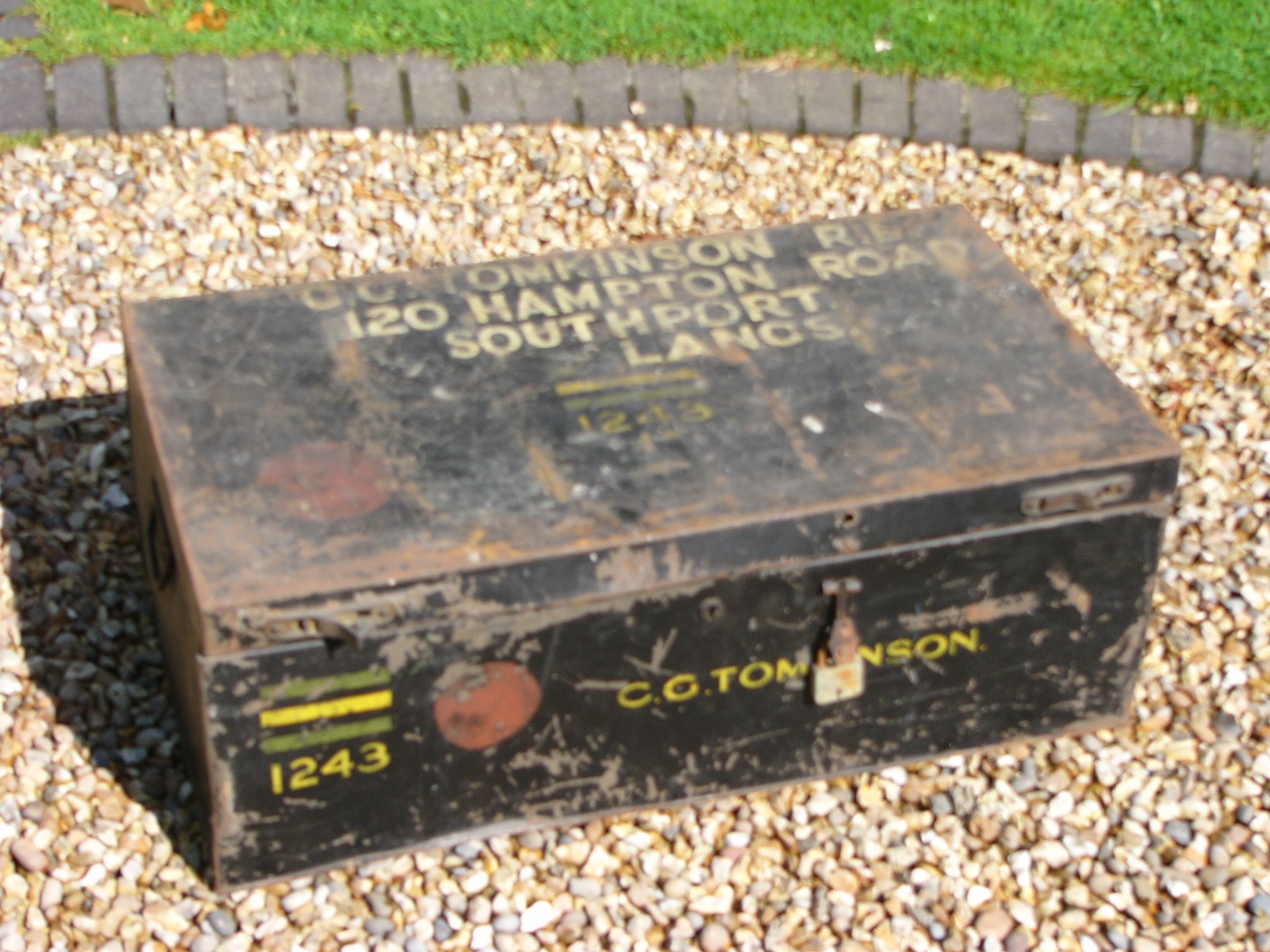
120 Hampton Road, Southport ( 1st floor)
Summer 1947, we moved to Braeside in Prenton.
Dad continued in the TA, being in command of 298 (Indep) Field Squadron RE(TA) for some years until he finally retired to concentrate on work.
Our advance parties had already taken over. Then this move was cancelled and we proceeded straight on to Naples where we embarked on M.T. and were taken over to the South of France and followed up behind the 5th Army. We were moved up through France , with our interpreter Jacques Theil (who later ran the Cafe Kleber near the Eiffel Tower) and Belgium and finally were bivouac billeted in Ghent. From here we were sent on leave to the U.K. and all members of the Unit during the next two months had a period of leave in the U.K. after an absence of over four years. This coupled with our civilised environment did a tremendous amount of good to the Unit and when we took over a position in the line once more, the unit was fit for anything. Prior to this we had undergone extensive training in river crossing and the latest technique against mines which had been encountered in Germany.
GERMANY
We saw the Air Armada for the river crossing over the Rhine and shortly and then afterwards we moved up towards Wesel and passed over the Rhine via Munster Osnabrucke, Hanover, Celle where we took an active part working with the Scottish Division. Our job was mainly road clearance - maintenance of tracks and improvised bridges - until after we had crossed the river Elbe. Here the division was directed on to Lubeck with the 17th Brigade. In the advance the brigade advanced on two roads with the forest in between them. One platoon accompanied the left hand battalion and the remainder of the Company moved up behind the main units on the main road. We spent all the time in clearing road blocks and on the day before the Armistice, one of our parties was caught on the left hand track in the open whilst clearing some road blocks and making good the road to enable the equipment to move up to the Seaforth Highlanders. They were heavily shelled by 2-Tiger Tanks left behind in a wood about 1,800 yards away and all eleven including Sgt Speirs? were completely destroyed. We built a small Bailey Bridge before Lubecke and I think it was one of the last operational bridges in Europe, so that we had the distinction of having completed the first one and the last one. We moved into Lubecke and our first tasks were the clearance and neutralising of the airfields and dock roads and arms dumps in the neighbourhood and then the preparation for the Victory celebrations. The Company constructed the Review Stand for the Victory Parade in Lubecke.
We took over all RE equipment and had the good fortune to take over several hundred German assault boats and mechanical oars, the local sailing club and many other amenities which needless to say we put to good use -
No sooner had we got settled than we were moved to Wisma and from there to Schwain where one of our main tasks was the setting up of the Divisional Sailing Club on the lake - from Schwein we moved to Magdeberg opposite the Russians and our job here was the clearance of the canal from Magdeberg to Brunswick of the eight or ten bridges which had been blown and dropped into the canal. Our task was the removal of 3 of these and in addition we got the lift Bridge of the Luzer? to the Elbe canal in working order and were able to bring out altogether over 80,000 tons of shipping - an interesting point was whilst bringing shipping from the Elbe, the Russians on the opposite shore mortared the area so we had to leave the barge nearest to them to its fate - as soon as this had been completed - the unit then moved back to Brunswick and finally to a small village south of Brunswick called Salz-Gitta - a mining village on the Herman Goering Iron Ore and Steelworks organisation. it was a modern village with plenty of comfortable houses into which we ensconced ourselves - and main task from now on was as follows * The clearing of the Bridges on the main canals - the two biggest being the one on the main Brunswick to Hanover road, where two large steel and concrete bridges has been dropped into the canal and had been replaced with an American trestle bridge. The central span had to be increased on this bridge to take all the canal traffic and also the heavy vehicles on the main road. When we were halfway through this it was found that the approach spans in theory were class 9 � although they had taken class 70. This was not good enough for the Deputy Chief Engineer of works and we then had to increase the strength of the approach spans as well - this bridge was known as Tomky's Folly and lasted a long time - we used divers on the other bridge and blew the connecting links underwater and then tried to pull it out with blocks and tackle - we eventually pulled sufficient of it out to allow the water traffic to pass through : the next main job was the construction of a Refugee Camp for 10,000 people and this was done in little over six weeks. This included all the roads, sewers, cooking huts, ablutions, sanitation, the building of over 100 Nissen huts, 10 large Nissen huts as cook houses 10 large wooden ablution huts and 100 tents we also built several semi-panelling Bailey bridges in the area & one we dismantled an improvised bridge made out of Austrian Alp decking & this we sold to the local timber merchant and swelled the funds of the unit to no small degree. During the whole of this time the unit was being run down and with ? the least demobilisation & various reinforcements were coming forward. Suitable changes were made as time went along and in Jan 1946 I handed over the unit to Major Russell.
HOME- January 1946
120 Hampton Road, Southport ( 1st floor)
Summer 1947, we moved to Braeside in Prenton.
Dad continued in the TA, being in command of 298 (Indep) Field Squadron RE(TA) for some years until he finally retired to concentrate on work.