PERSIA
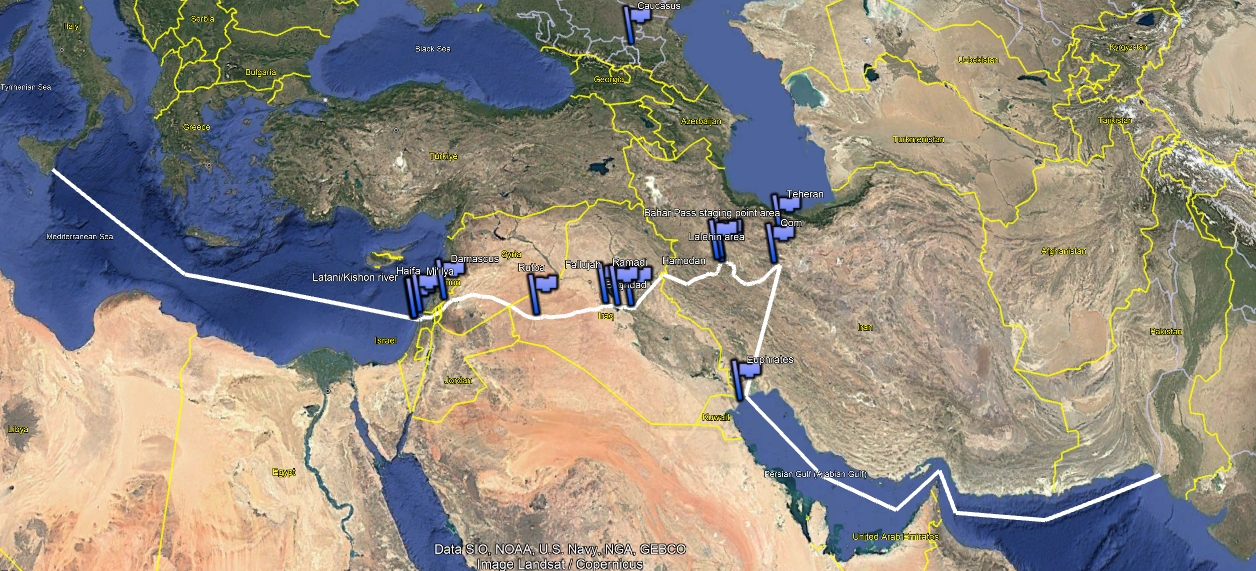
We sailed up the Euphrates and commenced the disembarking at Shiva and went into a transit camp. My only recollections of it were the excessive heat, about 115 degF in the shade, an enormous number of flies and a strong yellowing of my complexion. I then went into hospital with acute Jaundice and touch of Malaria. The Unit suffered in Shiva for some days before the transport arrived, they were then able to make off into the higher grounds of Persia to a town named Qum. The railway journey from the main body was memorable for the innumerable curves in the railway, acute curves which caused the train wheels to shriek and shout as it went up the grade to the Mesava Hills. The Unit eventually completed its journey towards the middle of September, having travelled over 6,000 miles in a very short space of time.
My knowledge of what the unit did was a little vague until I rejoined in Jan 43 to command, but like all other Units in the division, they were employed in water supply which was very difficult and not of the best, the construction of roads and tracks and camps for various units in the brigade. They also started to learn the new mine drill which had just come out from England. This was a most complicated business and we were very glad that eventually it was succeeded by a much simpler one which had come straight from the 8th Army, then preparing for the assault at Alamein. The life in Persia was quite hard for we only had tents and stone walls built round outside to keep the worst of the wind out. We eventually constructed huts - the men made bricks for the walls and used poles for the roof structure and thatched the roofs with straw covered with mud. This was extremely inflammable especially as we used the oil and water stoves. These we found were much improved when primed with a small amount of petrol. Several of the malaria casualties from Madagascar caught malaria again and we lost Corporal Divine through malaria.
Various reconnaissances were made by the C.R.E. and Commanders towards the Caspian, but the co-operation of the Russians was very meagre and they were extremely suspicious of everything we did.
The area north of Kulba? between Burmit? and Teheran was recced for the purpose of delaying any southwards thrust by the German, should they break through the Caucasus. Visits were organised to the Golden Mosque at Qum, also to Teheran and Isfahan where the usual carpets, silverware etc., were bought. The sort of things one remembers about Persia were the incredible distances one was able to see the mountains, especially those in the distance North of Teheran. We could see Mount Albrus, 18,000 ft. rising about the mountain range at the back of Teheran. A rather weary Christmas was spent in our draughty tents, especially as the nights were so cold that the water froze in our basins and the days were quite hot. Luckily, we were once more on the move and left Qom on the 18th Jan and went via Hamadan Bahar Pass to Baghdad; the snow around the Bahar Pass was up to 2ft. deep beyond Hamadan where we had a staging point. We arrived at 4 o'clock in the evening and the advance party was there to meet us. There was a pile of tents in the field by the roadside and that was all. We then had to set-to to erect the tents and settle down for the night. We all got our "Primus" Stoves going and the soft snow soon trampled down and melted. We sat on our camp beds and ate our evening meal; needless to say, there was a rum ration for everyone and eventually we went to sleep. I don't think many people took many clothes off that night. When we awoke in the morning (it had been freezing hard in the night and all the beds had frozen to the tent floor and had sunk in about 6" in the soft snow and mud and then frozen up again), we had the greatest difficulty in getting out. The trip down to the Bahar Pass from Lalehin mountain plateau around Hamadan was most interesting. We passed from extreme cold to the warm plains of Iraq and by the end of the day we were in sweltering heat and with our shorts on. We stayed at Baghdad for the day and had the greatest difficulty in ensuring that all our arms were with us when we left. Lancer Camp was notorious for the thieving racket that went on. We re-adjusted our equipment and mode of living and set off across the desert from Baghdad to Ramadi through Falluja and then on to the Wells through the desert at Rutba; from Rutba we went up to Damascus and went into a Brigade Camp outside Damascus. The Unit then went from there to a camp near Haifa whilst the O.C. proceeded to Cairo. The original intention was that the division should join the 8th Army and take over roundabout in Fiedaville, but this was cancelled as the 8th Army had done so well and our presence was not necessary. We then had to report to a planning headquarter outside Cairo where we took part in the planning operation "Husky", that is the assault on Sicily. The 5th division was to be one of the assault divisions and 17th brigade one of the assault brigades. The 38th Field Co. naturally had a big part to play as from aerial photograph it was obvious that there were many engineer problems on the beaches already. From the Planning Headquarters, we obtained a very good idea of what our problems were to be and we were then able to go back to the Unit and as part of the Brigade the many tasks ahead of us were practiced until we did the actual landing in Sicily. From Haifa we carried out bridging operations over the river Latani (now Kishon), the local river which ran out into the harbour at Haifa. We built an improvised small box girder bridge out of YBE equipment to extend the length of the Divisional Bridging Equipment. The small box girder was used as a landing bay and was most successful and we were able to put the heaviest divisional transport across it. After some weeks in Haifa, when we brought ourselves up to full strength in men and equipment, having two additional officers posted to us - one Drew the other ?- we then took our turn at the combined operations at the training centre at Kabri where we learnt all about the many specialist pieces of equipment designed for assault landing. Various schemes were carried out including day and night exercises and by the end of three weeks/to one month, we spent at Kabri we reckoned that we needed little else except some leave before we started our final operation. We went back to Haifa and from there we did the pre-loading for our vehicles and equipment and so on for a practice operation in the Gulf of Aqaba. The conditions we were supposed to meet on the beaches of Sicily were to be reproduced on the beaches of the Gulf of Aqaba and we were to do our landing on these beaches to practice ourselves in this operation. We sailed from Port Said through the Red Sea and up into the Gulf of Aqaba. The conditions were rather warm to say the least and I must confess that I felt the tremendous effort that had been put into this exercise didn�t benefit the people who took part in it to the degree that it should have done, but it is very difficult to simulate mine fields when there aren�t any and when the troops were half way across a mine field rushing up and saying they were all blown up. Despite these minor snags, we eventually breached our way through the mine fields and laid down our army track and some of our track and our transport was disembarked and the Brigade moved on to its first objective in the Hills at the back of Aqaba. This was the most frightful part of the exercise as it took part in the middle of the day when it was extremely hot and few of the participants cared whether they got through or not. After capturing the first objective, we reported back to the beach and bivouacked amongst the palms until we were given permission to bathe which was very welcome and then after lunch we were ferried back to the ships and eventually steamed back to Port Said, thankful that the exercise was over. We then returned to Mi'ilya near Kabri from which we did not move until we embarked on the final ships for Sicily. One of the leave parties had the misfortune to be driven over the edge of the road on the way down to Beirut and we lost two men killed and about eleven seriously injured. Luckily all but two of these seriously injured ones rejoined before the Sicily operation, but our Q.M. we did not see again for some months.
We sailed up the Euphrates and commenced the disembarking at Shiva and went into a transit camp. My only recollections of it were the excessive heat, about 115 degF in the shade, an enormous number of flies and a strong yellowing of my complexion. I then went into hospital with acute Jaundice and touch of Malaria. The Unit suffered in Shiva for some days before the transport arrived, they were then able to make off into the higher grounds of Persia to a town named Qum. The railway journey from the main body was memorable for the innumerable curves in the railway, acute curves which caused the train wheels to shriek and shout as it went up the grade to the Mesava Hills. The Unit eventually completed its journey towards the middle of September, having travelled over 6,000 miles in a very short space of time.
My knowledge of what the unit did was a little vague until I rejoined in Jan 43 to command, but like all other Units in the division, they were employed in water supply which was very difficult and not of the best, the construction of roads and tracks and camps for various units in the brigade. They also started to learn the new mine drill which had just come out from England. This was a most complicated business and we were very glad that eventually it was succeeded by a much simpler one which had come straight from the 8th Army, then preparing for the assault at Alamein. The life in Persia was quite hard for we only had tents and stone walls built round outside to keep the worst of the wind out. We eventually constructed huts - the men made bricks for the walls and used poles for the roof structure and thatched the roofs with straw covered with mud. This was extremely inflammable especially as we used the oil and water stoves. These we found were much improved when primed with a small amount of petrol. Several of the malaria casualties from Madagascar caught malaria again and we lost Corporal Divine through malaria.
Various reconnaissances were made by the C.R.E. and Commanders towards the Caspian, but the co-operation of the Russians was very meagre and they were extremely suspicious of everything we did.
The area north of Kulba? between Burmit? and Teheran was recced for the purpose of delaying any southwards thrust by the German, should they break through the Caucasus. Visits were organised to the Golden Mosque at Qum, also to Teheran and Isfahan where the usual carpets, silverware etc., were bought. The sort of things one remembers about Persia were the incredible distances one was able to see the mountains, especially those in the distance North of Teheran. We could see Mount Albrus, 18,000 ft. rising about the mountain range at the back of Teheran. A rather weary Christmas was spent in our draughty tents, especially as the nights were so cold that the water froze in our basins and the days were quite hot. Luckily, we were once more on the move and left Qom on the 18th Jan and went via Hamadan Bahar Pass to Baghdad; the snow around the Bahar Pass was up to 2ft. deep beyond Hamadan where we had a staging point. We arrived at 4 o'clock in the evening and the advance party was there to meet us. There was a pile of tents in the field by the roadside and that was all. We then had to set-to to erect the tents and settle down for the night. We all got our "Primus" Stoves going and the soft snow soon trampled down and melted. We sat on our camp beds and ate our evening meal; needless to say, there was a rum ration for everyone and eventually we went to sleep. I don't think many people took many clothes off that night. When we awoke in the morning (it had been freezing hard in the night and all the beds had frozen to the tent floor and had sunk in about 6" in the soft snow and mud and then frozen up again), we had the greatest difficulty in getting out. The trip down to the Bahar Pass from Lalehin mountain plateau around Hamadan was most interesting. We passed from extreme cold to the warm plains of Iraq and by the end of the day we were in sweltering heat and with our shorts on. We stayed at Baghdad for the day and had the greatest difficulty in ensuring that all our arms were with us when we left. Lancer Camp was notorious for the thieving racket that went on. We re-adjusted our equipment and mode of living and set off across the desert from Baghdad to Ramadi through Falluja and then on to the Wells through the desert at Rutba; from Rutba we went up to Damascus and went into a Brigade Camp outside Damascus. The Unit then went from there to a camp near Haifa whilst the O.C. proceeded to Cairo. The original intention was that the division should join the 8th Army and take over roundabout in Fiedaville, but this was cancelled as the 8th Army had done so well and our presence was not necessary. We then had to report to a planning headquarter outside Cairo where we took part in the planning operation "Husky", that is the assault on Sicily. The 5th division was to be one of the assault divisions and 17th brigade one of the assault brigades. The 38th Field Co. naturally had a big part to play as from aerial photograph it was obvious that there were many engineer problems on the beaches already. From the Planning Headquarters, we obtained a very good idea of what our problems were to be and we were then able to go back to the Unit and as part of the Brigade the many tasks ahead of us were practiced until we did the actual landing in Sicily. From Haifa we carried out bridging operations over the river Latani (now Kishon), the local river which ran out into the harbour at Haifa. We built an improvised small box girder bridge out of YBE equipment to extend the length of the Divisional Bridging Equipment. The small box girder was used as a landing bay and was most successful and we were able to put the heaviest divisional transport across it. After some weeks in Haifa, when we brought ourselves up to full strength in men and equipment, having two additional officers posted to us - one Drew the other ?- we then took our turn at the combined operations at the training centre at Kabri where we learnt all about the many specialist pieces of equipment designed for assault landing. Various schemes were carried out including day and night exercises and by the end of three weeks/to one month, we spent at Kabri we reckoned that we needed little else except some leave before we started our final operation. We went back to Haifa and from there we did the pre-loading for our vehicles and equipment and so on for a practice operation in the Gulf of Aqaba. The conditions we were supposed to meet on the beaches of Sicily were to be reproduced on the beaches of the Gulf of Aqaba and we were to do our landing on these beaches to practice ourselves in this operation. We sailed from Port Said through the Red Sea and up into the Gulf of Aqaba. The conditions were rather warm to say the least and I must confess that I felt the tremendous effort that had been put into this exercise didn�t benefit the people who took part in it to the degree that it should have done, but it is very difficult to simulate mine fields when there aren�t any and when the troops were half way across a mine field rushing up and saying they were all blown up. Despite these minor snags, we eventually breached our way through the mine fields and laid down our army track and some of our track and our transport was disembarked and the Brigade moved on to its first objective in the Hills at the back of Aqaba. This was the most frightful part of the exercise as it took part in the middle of the day when it was extremely hot and few of the participants cared whether they got through or not. After capturing the first objective, we reported back to the beach and bivouacked amongst the palms until we were given permission to bathe which was very welcome and then after lunch we were ferried back to the ships and eventually steamed back to Port Said, thankful that the exercise was over. We then returned to Mi'ilya near Kabri from which we did not move until we embarked on the final ships for Sicily. One of the leave parties had the misfortune to be driven over the edge of the road on the way down to Beirut and we lost two men killed and about eleven seriously injured. Luckily all but two of these seriously injured ones rejoined before the Sicily operation, but our Q.M. we did not see again for some months.