SICILY- Operation Husky 10th July 1943
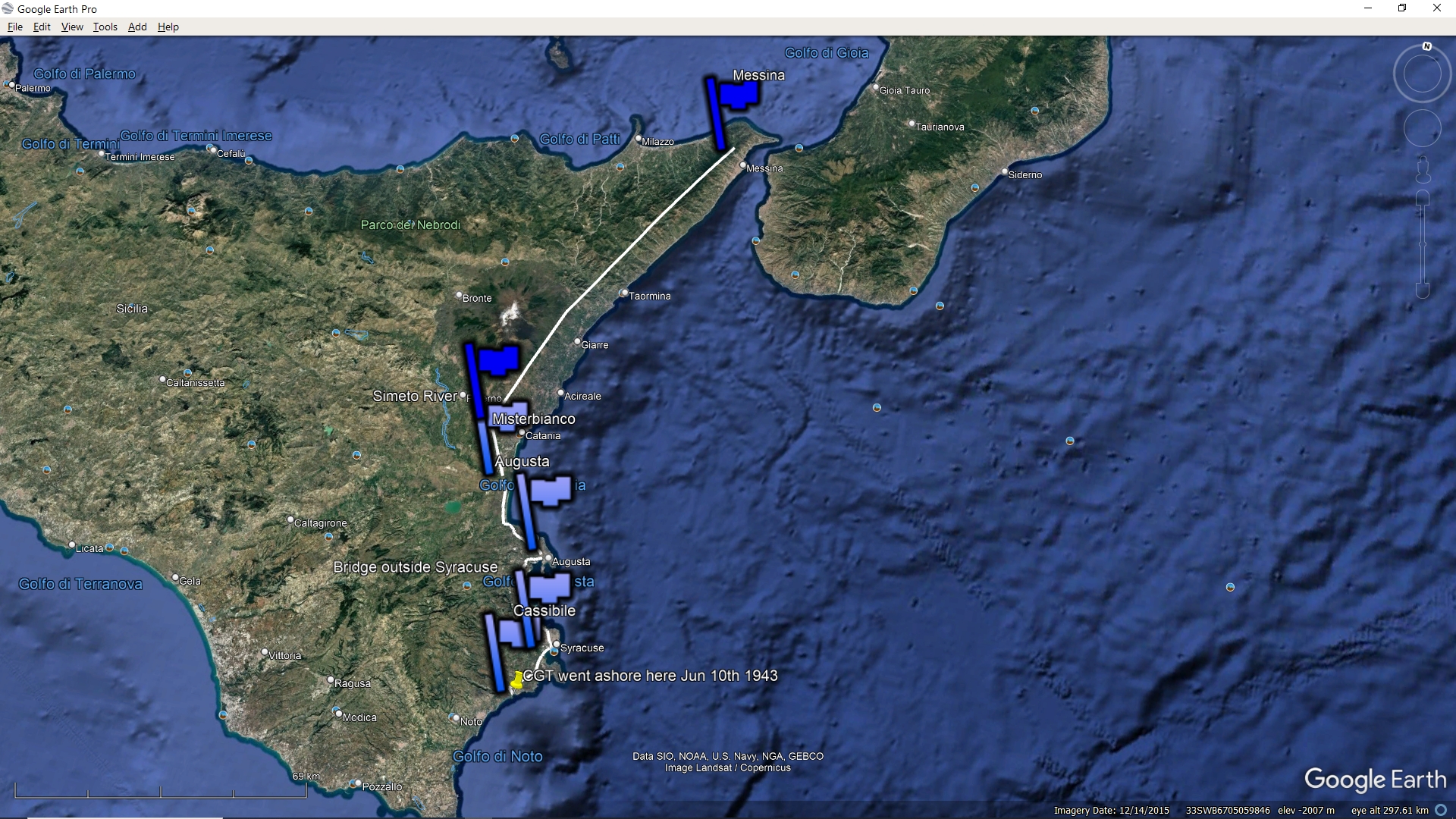
The unit was as follows: Tomkinson, O.C. Smith 2/I/C and Lucas Commanding 1 Platoon, Brighton Commanding 2 Platoon, Godsell commanding 3 Platoon and two reinforcement officers. Lieuts. Drew and Towns, the Sgt. Major was S.M. Mathers, 1 Platoon Sct. Bishop, 2 Platoon Sgt. Carroll and 3 Platoon Sgt. Bryer. M. T. Sgt. was Sgt. Phillips, H.Qs. Sgt. was Sgt. Lindsay. Corporal Wood who had been to Burma with Godsell had the misfortune to lose his leg in a train accident. We embarked round about the beginning of May and the unit was divided up into reconnaissance parties, mine gapping parties, road laying parties and then the main body. The various parties travelled in their respective ships so that they would be disembarked at the right time and, on the whole, everything happened as it should have done. We encountered the mines on the beaches and these were recced and gaps were made through them, reconnaissance parties were leading Infantry and by the time that the main body arrived at the beach, preliminary gaps had been made through the minefield for M.T. Personnel were already proceeding through at a rapid rate, the main snag was the Navy. Despite having agreed to put the M.T. boats in two at a time, decided at the last moment on their own initiative to send the whole six in line ahead and they grounded on our sandbank, 60 yards from the shore enthusiastic Naval Officers ordered the doors down and urged the transport into the water; needless to say the majority of it disappeared and great was the consternation of the Brigadier and many others, as no transport was coming ashore. Luckily, we had a bulldozer fairly high up on the priority list and this came ashore with only the driver's head and shoulders and the extensions of the exhaust pipes showing. Shortly afterwards, it was followed by a flail tank and we then proceeded to haul the submerged vehicles ashore and all eventually went well. Shortly after we were ashore, there was an Italian tank going down towards the beach and we were able to stop it - luckily the Seaforth Islanders don't admit, although they expected our Flail Tank to have to go and deal with it, whilst the Brigadier wasn�t very enthusiastic as we were all very mind conscious of this tank, we pushed on up the road to Cassibile and got some sort of order out of the Chaos, but accomplished the initial landing. I had with me at this time Col. Henniker, C.R.E. of the Airborne Division, whom we had picked up in rather a sorry state having been wounded on the landing. We lent him a vehicle and he and his batman disappeared to round up his unit which had been dropped in the sea on the beaches and in on the edge of the hills - the fighting was not very severe and the Brigade pushed on up the road throughout the day and towards evening were outside Syracuse- Our first main objective - this was captured that night and our only job was the clearing of the main road of mines to ensure its use. Luckily the bridge which we all expected to be blown just outside Syracuse was intact and we did not need the equipment which was now being landed. The next day we pushed on towards Augusta and arrived outside Augusta that night and took the place during the early morning. Here again, our only task was the clearing of roads and suspected minefields, although these were very few in number. The enemy had withdrawn from Augusta and lined the ridge just outside the town a few hundred yards away. During the night the Brigade was heavily attacked by the enemy and the enemy air force and one of the planes being shot down just as it was dropping a very heavy bomb which fell in the field in which the unit was dug in. We suffered severe casualties, twenty seven being killed and thirty wounded. The crater was about 55 ft., in diameter and 30 ft. deep and many of us had remarkable escapes. The 2I/C was badly wounded and a lot of men were too. The Sgt. Major was killed and Sgt. Carrol was promoted in his place. The following morning our 4.2 mortars set out below our farmhouse and despite them asking them to move, loosed off a few rounds before doing so. Two of them hit the overhead cables outside the house and detonated and killed four of our men and wounded six more. We then got orders to provide a Platoon for a further assault landing up the coasts and myself and Godsell commanding 3 Platoon plus O/C plus small HQ set about reloading our equipment for this further assault up the coast which was on a much smaller scale than the previous two days. This was then cancelled and the Brigade moved into reserve and fresh troops pushed on up the road. Our next task was to get some information about the main road built bridge outside Catania and Lt. Drew did a reconnaissance down the road through Lentini on towards Catania and brought back the first accurate R.E. report of the main bridge, which was being held by the Paratroops. His report came on the wireless and we were then receiving over fifty miles and it speaks well for the wireless abilities of the unit. Our casualties on the actual landing were 6 wounded and this was very good considering the difficulties that had been encountered. Various types of mines which we had not seen before, we lifted and we all felt that we knew quite a lot about them by now. We then moved up the main road and took our position in support of our Brigade which was then manning the river line at the Simeto. We were bivouacked in a field and the flat plain was? overlooked from the German lines, which rose into the hills towards Catania-Mista Bianco-St. Ferro. Whilst here we received reinforcements and we set to teach them what we had learnt through our own experience. The first job of course was mines of which we had had a considerable number. Whilst approximately eleven of these men were being trained, the haystack behind which they were encamped was hit by an enemy shell and the mines, which were without their detonators, were hit and the whole eleven of them were blown up. This was a terrible blow and was felt by the whole unit for a considerable time - coming on top after such heavy casualties over the last few days. During this period we were employed on making roads, brigade waterpoints and assisting the Infantry Battalions in the production of booby traps and time bombs which were placed in suitable enemy locations during the night patrols. Quite a few enemy vehicles were destroyed in this way. Eventually with the Division on our left, the 78th Division capturing the Century, the Germans started to withdraw and we pushed forward across the Simeto. 245 Fd. Coy. had built this bridge earlier on in the campaign but the division had never moved across it - apart from some small reconnaissance units in the beginning.
The enemy had left the tracks/roads in front of us heavily mined owing to the demolition of their ammunition dumps, the area and roads were strewn with, mainly, butterfly bombs which were in a fairly dangerous condition. We knew about these from the bombing we had had and we were well aware of the danger. Unfortunately, the mine lifting party on sweeping the road picked one up and the person who picked it up was killed and his two assistants were wounded. We eventually achieved our objective, which was Misterbianco and there the division was put into reserve, as by this time the Americans were practically up to Messina and the 78th Division were pushing on and only a small number of troops could be used on the coastal road up to Messina from Catania. Thus ended our career in Sicily and we took time to sort ourselves out and make ourselves comfortable for the time being. The C.R.E. Col. Abrahams left us about two days before the end of the operation and his place was taken by Col Osborne who had come from the 50 Division. Whilst in our billeting area we were told about the Bailey Bridge and parties had already been sent on courses and we got our first opportunity of training with this bridge. Our immediate task was the assault on Italy and our Brigade was one of the Assault Brigades - the 5th Division who were to be on the right with the 1st Canadian Division on the left - prior to this, we carried out the usual training and re-organisation and re-equipping and the unit was now as follows:
O.C. Tomkinson.
2 I/C Capt. Godsall.
1 Pln. Lt. Drew. 2 Pln. Lt. Brighton. 3 Pln. Lt. Pengelly who had just joined us;
The H.Q. Officers being Hughes and Augusta.
We had been introduced to enemy fighter attacks - night bombing and co-operation of aircraft with troops on our own side and the use of tanks and so in quite a short campaign we had assimilated a lot of essential knowledge to help us on our way.
The unit was as follows: Tomkinson, O.C. Smith 2/I/C and Lucas Commanding 1 Platoon, Brighton Commanding 2 Platoon, Godsell commanding 3 Platoon and two reinforcement officers. Lieuts. Drew and Towns, the Sgt. Major was S.M. Mathers, 1 Platoon Sct. Bishop, 2 Platoon Sgt. Carroll and 3 Platoon Sgt. Bryer. M. T. Sgt. was Sgt. Phillips, H.Qs. Sgt. was Sgt. Lindsay. Corporal Wood who had been to Burma with Godsell had the misfortune to lose his leg in a train accident. We embarked round about the beginning of May and the unit was divided up into reconnaissance parties, mine gapping parties, road laying parties and then the main body. The various parties travelled in their respective ships so that they would be disembarked at the right time and, on the whole, everything happened as it should have done. We encountered the mines on the beaches and these were recced and gaps were made through them, reconnaissance parties were leading Infantry and by the time that the main body arrived at the beach, preliminary gaps had been made through the minefield for M.T. Personnel were already proceeding through at a rapid rate, the main snag was the Navy. Despite having agreed to put the M.T. boats in two at a time, decided at the last moment on their own initiative to send the whole six in line ahead and they grounded on our sandbank, 60 yards from the shore enthusiastic Naval Officers ordered the doors down and urged the transport into the water; needless to say the majority of it disappeared and great was the consternation of the Brigadier and many others, as no transport was coming ashore. Luckily, we had a bulldozer fairly high up on the priority list and this came ashore with only the driver's head and shoulders and the extensions of the exhaust pipes showing. Shortly afterwards, it was followed by a flail tank and we then proceeded to haul the submerged vehicles ashore and all eventually went well. Shortly after we were ashore, there was an Italian tank going down towards the beach and we were able to stop it - luckily the Seaforth Islanders don't admit, although they expected our Flail Tank to have to go and deal with it, whilst the Brigadier wasn�t very enthusiastic as we were all very mind conscious of this tank, we pushed on up the road to Cassibile and got some sort of order out of the Chaos, but accomplished the initial landing. I had with me at this time Col. Henniker, C.R.E. of the Airborne Division, whom we had picked up in rather a sorry state having been wounded on the landing. We lent him a vehicle and he and his batman disappeared to round up his unit which had been dropped in the sea on the beaches and in on the edge of the hills - the fighting was not very severe and the Brigade pushed on up the road throughout the day and towards evening were outside Syracuse- Our first main objective - this was captured that night and our only job was the clearing of the main road of mines to ensure its use. Luckily the bridge which we all expected to be blown just outside Syracuse was intact and we did not need the equipment which was now being landed. The next day we pushed on towards Augusta and arrived outside Augusta that night and took the place during the early morning. Here again, our only task was the clearing of roads and suspected minefields, although these were very few in number. The enemy had withdrawn from Augusta and lined the ridge just outside the town a few hundred yards away. During the night the Brigade was heavily attacked by the enemy and the enemy air force and one of the planes being shot down just as it was dropping a very heavy bomb which fell in the field in which the unit was dug in. We suffered severe casualties, twenty seven being killed and thirty wounded. The crater was about 55 ft., in diameter and 30 ft. deep and many of us had remarkable escapes. The 2I/C was badly wounded and a lot of men were too. The Sgt. Major was killed and Sgt. Carrol was promoted in his place. The following morning our 4.2 mortars set out below our farmhouse and despite them asking them to move, loosed off a few rounds before doing so. Two of them hit the overhead cables outside the house and detonated and killed four of our men and wounded six more. We then got orders to provide a Platoon for a further assault landing up the coasts and myself and Godsell commanding 3 Platoon plus O/C plus small HQ set about reloading our equipment for this further assault up the coast which was on a much smaller scale than the previous two days. This was then cancelled and the Brigade moved into reserve and fresh troops pushed on up the road. Our next task was to get some information about the main road built bridge outside Catania and Lt. Drew did a reconnaissance down the road through Lentini on towards Catania and brought back the first accurate R.E. report of the main bridge, which was being held by the Paratroops. His report came on the wireless and we were then receiving over fifty miles and it speaks well for the wireless abilities of the unit. Our casualties on the actual landing were 6 wounded and this was very good considering the difficulties that had been encountered. Various types of mines which we had not seen before, we lifted and we all felt that we knew quite a lot about them by now. We then moved up the main road and took our position in support of our Brigade which was then manning the river line at the Simeto. We were bivouacked in a field and the flat plain was? overlooked from the German lines, which rose into the hills towards Catania-Mista Bianco-St. Ferro. Whilst here we received reinforcements and we set to teach them what we had learnt through our own experience. The first job of course was mines of which we had had a considerable number. Whilst approximately eleven of these men were being trained, the haystack behind which they were encamped was hit by an enemy shell and the mines, which were without their detonators, were hit and the whole eleven of them were blown up. This was a terrible blow and was felt by the whole unit for a considerable time - coming on top after such heavy casualties over the last few days. During this period we were employed on making roads, brigade waterpoints and assisting the Infantry Battalions in the production of booby traps and time bombs which were placed in suitable enemy locations during the night patrols. Quite a few enemy vehicles were destroyed in this way. Eventually with the Division on our left, the 78th Division capturing the Century, the Germans started to withdraw and we pushed forward across the Simeto. 245 Fd. Coy. had built this bridge earlier on in the campaign but the division had never moved across it - apart from some small reconnaissance units in the beginning.
The enemy had left the tracks/roads in front of us heavily mined owing to the demolition of their ammunition dumps, the area and roads were strewn with, mainly, butterfly bombs which were in a fairly dangerous condition. We knew about these from the bombing we had had and we were well aware of the danger. Unfortunately, the mine lifting party on sweeping the road picked one up and the person who picked it up was killed and his two assistants were wounded. We eventually achieved our objective, which was Misterbianco and there the division was put into reserve, as by this time the Americans were practically up to Messina and the 78th Division were pushing on and only a small number of troops could be used on the coastal road up to Messina from Catania. Thus ended our career in Sicily and we took time to sort ourselves out and make ourselves comfortable for the time being. The C.R.E. Col. Abrahams left us about two days before the end of the operation and his place was taken by Col Osborne who had come from the 50 Division. Whilst in our billeting area we were told about the Bailey Bridge and parties had already been sent on courses and we got our first opportunity of training with this bridge. Our immediate task was the assault on Italy and our Brigade was one of the Assault Brigades - the 5th Division who were to be on the right with the 1st Canadian Division on the left - prior to this, we carried out the usual training and re-organisation and re-equipping and the unit was now as follows:
O.C. Tomkinson.
2 I/C Capt. Godsall.
1 Pln. Lt. Drew. 2 Pln. Lt. Brighton. 3 Pln. Lt. Pengelly who had just joined us;
The H.Q. Officers being Hughes and Augusta.
We had been introduced to enemy fighter attacks - night bombing and co-operation of aircraft with troops on our own side and the use of tanks and so in quite a short campaign we had assimilated a lot of essential knowledge to help us on our way.